
I love this walk through the TV guide by Steven Montano. What's your favorite scifi or fantasy show?
Fantasy and Sci-Fi You Should Watch

I love this walk through the TV guide by Steven Montano. What's your favorite scifi or fantasy show?
Today on the Guild of Dreams, I muse about word counts and making words count.
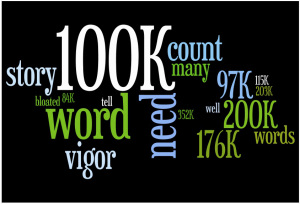
How many words do you need to tell a story well? Conventional wisdom (as stated by Chuck Sambuchino in Writer’s Digest) says a novel should be under 100,000, and one seasoned author in my circle claims that any book longer than 100K either has bloated prose or should be split into two novels.
The 100K edict serves two purposes. First, it discourages inexperienced writers from padding their narratives the way high school students pad term papers to make the assigned 10-page minimum. Second, it holds down production costs. Whether the publisher is one of the Big Five, a small independent press, or an indie author, spending more money to produce a longer book is a poor business decision, unless you can be reasonably sure people will buy it. For instance, Tolkien considered Lord of the Rings a single novel, yet it was published in three volumes because his publisher…
View original post 772 more words
A little more than a year ago, I began following Autumn Birt on Twitter and reading her blogs No Map Nomads and the Guild of Dreams. A wonderfully inventive fantasy and science fiction writer, Autumn has opened my eyes to the ins and outs of the indie publishing world, not to mention opened some doors … Continue reading The Work in Progress Blog Tour
(This post also appeared on my website.) Why do authors make their books available for free? Among the indies, it's a common practice to bring our work to a wider readership. In my case, I want to get as many people to read my work as I can, and when I offer one of the Woern … Continue reading It’s October, and A Wizard’s Lot Is Free
Philip Athans’ distinction between science fiction and fantasy perfectly reflects my own views on the subject. This is why The Woern Chronicles are science fiction cloaked as fantasy–I explain the magic!
In the introduction to an episode of The Twilight Zone, Rod Serling said: “It’s been said that science fiction and fantasy are two different things. Science fiction—the improbable made possible. Fantasy—the impossible made probable.”
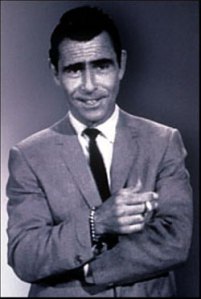 Science tells us that thing he’s holding in his hand is most likely why he died of a heart attack at age 50.
I wrote that down a couple weeks ago and have been puzzling over it ever since. “Probable,” “possible,” I’m not sure what he was getting at or who said it before him.
In the end I’m happy with whatever definition of SF and/or fantasy you’re willing to provide and am delighted by both genres both in the ways they’re different and the ways they’re the same—and the third thing: the way they interact and comingle with each other. Still, it’s an interesting question and one that is certainly germane to this blog.
You…
View original post 885 more words
Steven Montano reviews more cheesy fantasy movie favorites.
Not long ago, I wrote a post about some pretty awful fantasy movies, and why we love them in spite of their ultimate cheesiness (or, quite possible, because of it). In that first post I discussed Beastmaster, Willow and Legend. Now I have three more movies to get off my chest.
Hawk the Slayer

There’s a good chance you’ve never even heard of this bizarre fantasy flick, but I’m often surprised by how many people have heard of it. This movie has “the 80s” written all over it, from the flair of the opening credits to the overly synthesized music to the mist-filled cinematography…all that’s missing is Richard Simmons and a soundtrack by Phil Collins, and we’d be all set…
The evil Voltan (Jack Palance, breathing heavily and using his scowl to terrific effect) is the scourge of the land, and when he and his men kidnap the Abbess of a…
View original post 867 more words
If you’re going to do a prologue, do it right.
A few months ago I wrote about folding backstory into a narrative to give your readers the vital information they need without hitting them over the head with a history lesson. In that post, I quoted this received wisdom:
Don’t use prologues.
That advice comes from agents and traditional publishers who believe, based on the contents of their slushpiles, that “prologue” means “deadly boring waste of my time.”
 The actual definition of prologue is a separate introductory section of a literary work. Etymologically, the word comes from the ancient Greek prologos, which described the preamble to a play that established the setting and provided background information to enhance the audience’s understanding and appreciation of the drama. The Greeks may have given the prologue its name, but I’d lay odds they didn’t invent the literary device. Knowing human beings, I imagine we’ve been prefacing our stories since people could speak.
View original post 1,024 more words
Finally, a step-by-step guide to indie marketing.

 Why do we read? When I was young, I thought I liked stories for their plots. The books that caught my attention in the library or bookstore usually had a dragon, horse, or sword-wielder on the cover, promising hair-raising battles and edge of seat adventures. Give me Dragonflight or Lord of the Rings, Treasure Island or the Black Stallion. Nothing would raise my gag reflex so fast as the suggestion from a teacher or librarian that I might try a book with an “interesting” character whose problems I could “relate to.” Or so I thought.
 I thought I needed dragons or battles or at least horses to enjoy a book, yet at the same time I read and reread plenty of novels without them. There were the books with an ordinary bully instead of a dark overlord for a villain (Nellie Oleson vs Sauron), and there were even books…
View original post 871 more words
Scott Bury gets to the essence of fantasy world-building: give it some scientific underpinnings.
 http://fantasyartdesign.com/free-wallpapers/digital-art.php?u_i=43&i_i=138
Good fantasy writing has to maintain a strange tension, a balance that makes fantastic elements that are patently impossible believable.
The weekend before last, Chantal Boudreau wrote about basing her fantasy worlds and mythologies on the mythologies of Sami, Thracian, Serbian and Native American people.
I think this is a great idea for any writer of fantasy, because it adds many layers of meaning and symbolism to your writing. And it inspires a lot of ideas, too.
I did the same with my first published novel, The Bones of the Earth. While I made up the cosmology, all the mythology expressed by the characters, and many of the characters themselves, come from the mythologies and religions of ancient eastern European peoples, including the Greeks, Slavs, Germans, Celts and Scythians. Doing this also helped me choose names that didn’t sound like I coughed them out.
This…
View original post 237 more words


 AM Justice